Software engineered around how the business actually works.

Ezarven Binary designs and engineers custom software, enterprise systems and workflow automation around real operating requirements — supported by working product demonstrations and a disciplined delivery model.

Product proofTwo working demonstrations
Delivery lifecycleEight controlled stages
Engagement structuresFive indicative models
01 · Product proof

Working software, not presentation-only claims.

Ezarven ERP and Ezarven SRP were developed end-to-end by Anwer Qureshi and provide tangible evidence of product architecture, application engineering, workflow design and delivery execution. Both are presented through Ezarven Binary LLC as working pre-commercial demonstrations for controlled evaluation.

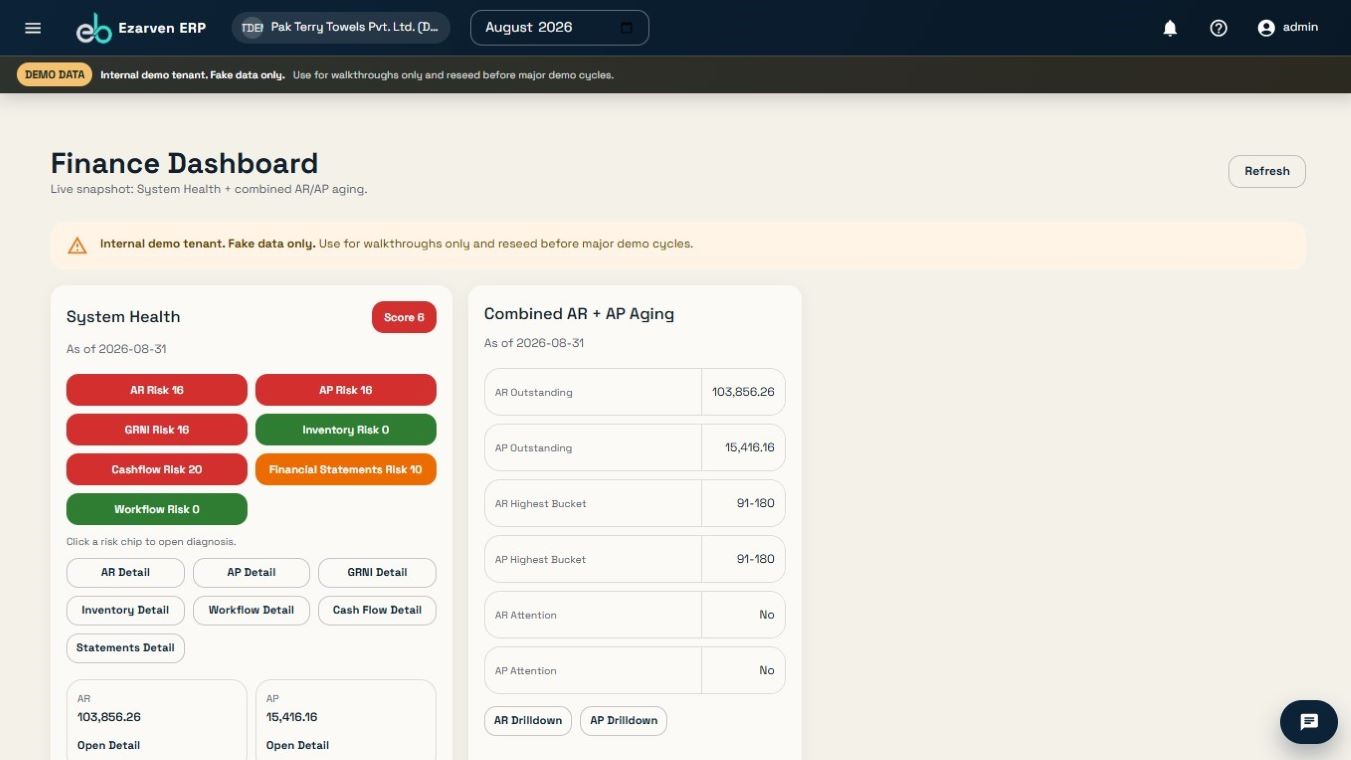
Ezarven ERP finance control dashboard using synthetic demonstration data
01 · Product proofWorking demo

Ezarven ERP

Enterprise Resource Planning Platform

A finance-led ERP for distribution and trading workflows, with controlled posting, procurement, sales, inventory, reporting and reconciliation.

Working demoPre-commercial
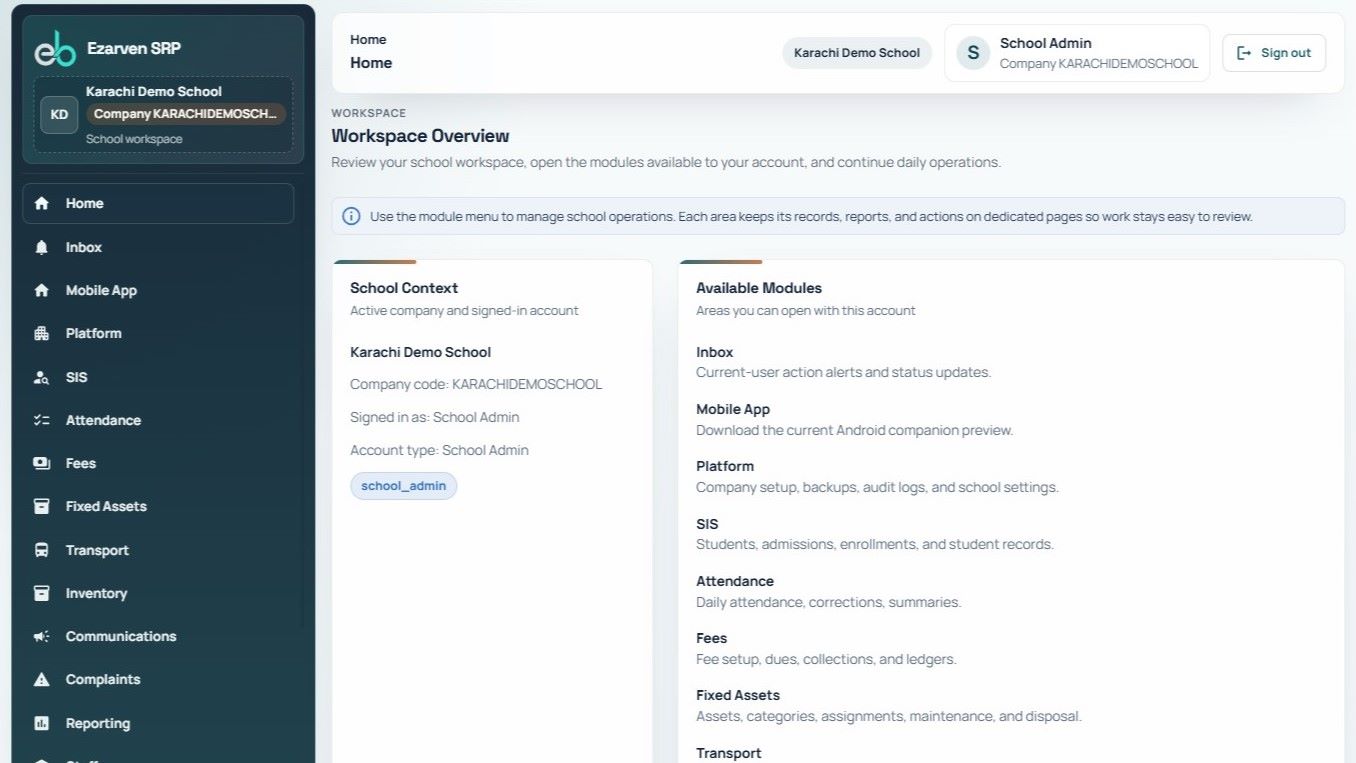
Ezarven SRP tenant-bound administrator workspace using synthetic data
02 · Product proofWorking demo

Ezarven SRP

School Resource Planning Platform

A tenant-aware school platform connecting student records, attendance, fees, academics, examinations, reporting and role-specific portals.

Working demoPre-commercial
02 · Services

Engineering capability from discovery to supported software.

The service portfolio is organised around operating problems, delivery responsibility and evidence — not around a list of technologies in isolation.

01

Custom software development

Purpose-built software for operating models that generic tools do not fit.

  • Internal business applications
  • Operational management platforms
  • Customer, supplier and partner portals
Explore Custom software development
02

AI and workflow automation

AI applied to a bounded business process with human accountability.

  • Human approval for material decisions
  • Defined input and output boundaries
  • Confidentiality and data-location review
Explore AI and workflow automation
03

ERP and business systems

Connected operational systems instead of fragmented records and duplicated work.

  • Process and data assessment
  • Workflow configuration
  • Custom operational modules
Explore ERP and business systems
04

Web and mobile applications

User-facing and workforce applications built around real roles and conditions.

  • Responsive business applications
  • Customer-facing platforms
  • Mobile workforce tools
Explore Web and mobile applications
05

Cloud, DevOps and systems integration

Deployment and integration foundations that make software easier to operate and change.

  • Cloud deployment design
  • CI/CD workflows
  • Application hosting configuration
Explore Cloud, DevOps and systems integration
03 · Solutions

Start with the operating pattern, then design the software.

These are illustrative solution blueprints — not customer case studies or fixed-scope offers. They show how recurring operational problems can be framed before architecture is committed.

Illustrative blueprint

AI-assisted operations control tower

A governed workflow for turning permitted operational events into prioritised human action.

ProblemOperational information is fragmented across systems, messages and teams, making exceptions and required action difficult to identify.
Explore blueprint
Illustrative blueprint

Digital application and decision workflow

Structured intake, evidence, review and decision states in place of email-and-spreadsheet processing.

ProblemApplications, evidence and approvals move through email, files and spreadsheets without a consistent status or decision trail.
Explore blueprint
Illustrative blueprint

Legacy workflow modernisation

A staged path from spreadsheet-heavy or fragile workflows to maintainable software with explicit controls.

ProblemA critical process depends on spreadsheets, manual duplication and undocumented knowledge.
Explore blueprint
04 · Industries

Domain context before technology choices.

Ezarven Binary uses sector context to sharpen discovery while avoiding unsupported claims of customer experience or regulatory authority.

01

Logistics and supply chain

Software for movement, fulfilment, operational visibility and exception control.

Movement · Visibility · Exception workflow
Explore context
02

Financial workflows and selected fintech contexts

Carefully governed software for financial operations, application workflows and decision-supporting records.

Application intake · Approvals · Audit-supporting records
Explore context
03

Selected operating contexts

Qualified opportunities in education, distribution, professional services and other suitable operational environments.

Education · Distribution · Operational systems
Explore context
05 · Delivery approach

A visible path from ambiguity to supported software.

Every stage has a clear purpose and output, while scope, acceptance, risk and operational responsibility remain visible.

  1. 01

    Discover

    Discovery summary, problem statement, assumptions and open questions.

  2. 02

    Define

    Requirements baseline, scope statement and Acceptance Criteria framework.

  3. 03

    Design

    Architecture, design artefacts, technical decisions and assumptions.

  4. 04

    Plan

    Statement of Work, milestones, responsibilities and commercial baseline.

  5. 05

    Build

    Working increments, source records, documentation and status evidence.

  6. 06

    Validate

    Test evidence, acceptance status, unresolved items and release decision.

  7. 07

    Deploy

    Deployed release, configuration evidence and handover materials.

  8. 08

    Support

    Support records, maintenance releases and improvement recommendations.

06 · Engagement models

Match the commercial structure to the certainty of the work.

Projects differ in scope certainty, pace and continuity. Ezarven Binary LLC selects an engagement structure that reflects the evidence, delivery responsibility and change profile of the work, with transaction-specific terms set through valid authority.

01

Fixed-price project

Defined scope, outputs, milestones and acceptance controls.

02

Time and materials

Flexible delivery against an approved backlog and reporting process.

03

Dedicated capacity

Reserved technical capacity for an agreed period and role structure.

04

Discovery engagement

Structured investigation before committing to a larger build.

05

Support retainer

Ongoing maintenance and controlled enhancement under an agreed scope.

07 · Partner channel

Local relationships without decentralising technical delivery.

Independent sales partners focus on market access and qualified introductions. Once appointed under the approved agreement, Ezarven Binary LLC retains central control over technical presales, pricing, contracting, delivery, quality and customer commitments.

Explore the partner model
A structured opportunity pathEZARVEN BINARY / PARTNERS
01Qualify

Partner identifies and qualifies

02Scope

Ezarven Binary leads technical discovery

03Propose

Ezarven Binary controls the commercial position

04Deliver

Ezarven Binary manages central execution

05Grow

Both support approved relationship roles

Anwer Qureshi, Founder and Chief Executive Officer of Ezarven Binary
08 · Leadership and accountability

Technical authorship with founder-led accountability.

Anwer Qureshi

Founder & Chief Executive Officer · Sole planner, investor and operator · Product Architect and Sole Developer — Ezarven ERP and Ezarven SRP

Anwer Qureshi is the Founder and Chief Executive Officer of Ezarven Binary and the sole planner, investor and operator behind the business.

He is the product architect and sole developer of Ezarven ERP and Ezarven SRP and leads the operating design of Ezarven Binary across product strategy, technical presales, commercial governance, partner enablement, project-delivery oversight and operational execution.

About Ezarven Binary

Bring one operating problem — not a finished specification.

Tell us what is changing, who uses the workflow, what is blocked and what a useful outcome looks like. The next technical conversation can start from that evidence.

Discuss a software requirement